
Project
The Research Project
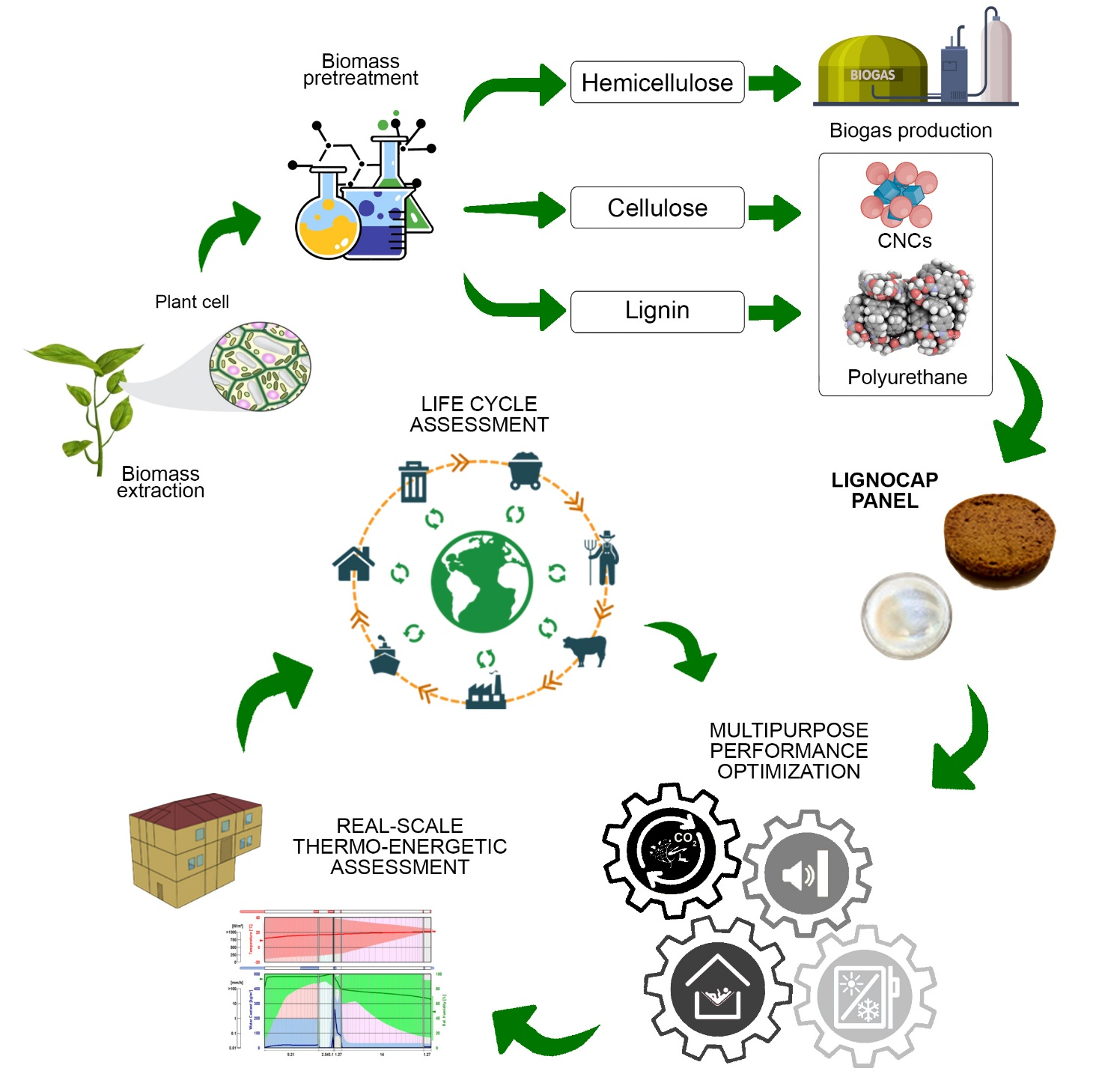
LIGNOCAP will develop a bio-based multipurpose insulation panel for environmental comfort in buildings with advanced thermo-acoustic performance, carbon capture capability, and long-term stability. This avant-garde solution will tackle hot temperatures in urban areas and guarantee excellent thermal comfort conditions and optimal acoustic performance when integrated into new buildings or used in their refurbishment and renovation. Indeed, it will affect local thermo-acoustic and air quality conditions, and minimise the use of air conditioning. As a by-product of biomass treatment processes, the here-developed lignin-polyurethane will have low embodied energy and represent a crucial step forward in the development of sustainable products for urban areas, consequently reducing Urban Heat Islands. The production process that will be developed in this project will allow efficient reuse of all products from biomass treatment, perfectly embodying the more intimate concepts of circular economy and sustainable development. To this aim, the project will exploit the full potential of a multi-objective and multidisciplinary optimization procedure aimed at defining the most promising production process that will allow to obtain the new generation of green insulation panels, by intimately connecting life cycle sustainability and performance assessment from the very start of the product development and design stage. The optimised properties of the panel will be integrated into some of the most common ready-to-use and customised dynamic component and building thermal-energy simulation tools. They will be assessed within new and existing constructions in terms of energy savings, optimised air conditioning use, and indoor thermal comfort conditions. A Life Cycle Assessment (LCA) of the panels will also be carried out to evaluate their environmental impact, considering the production phase, use phase, and the following end-of-life and final disposal.
Scope of the project
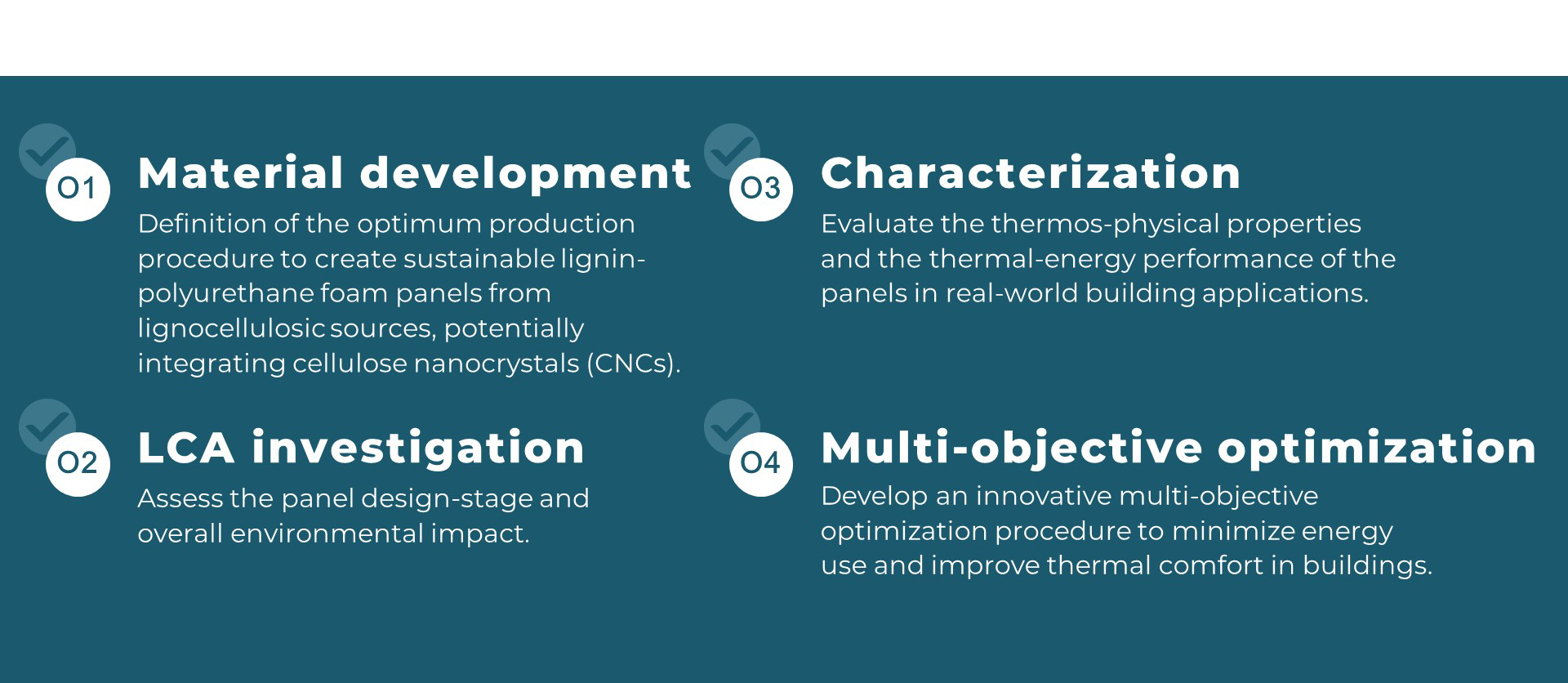
LIGNOCAP aims at developing and optimising advanced and low embodied energy building panels, using a multi-objective investigation procedure considering their thermal, acoustic, CO2 capture, and long-term stability performance, as well as their environmental sustainability in a life cycle perspective. In this framework, LIGNOCAP will shape the new frontier of energy-efficient, comfortable, and sustainable building design and retrofit, while creating healthier and more productive conditions and improved quality of life for occupants, ultimately responding to the broad social opportunity and tremendous challenge of a more resilient built environment.
Main project objectives and research questions
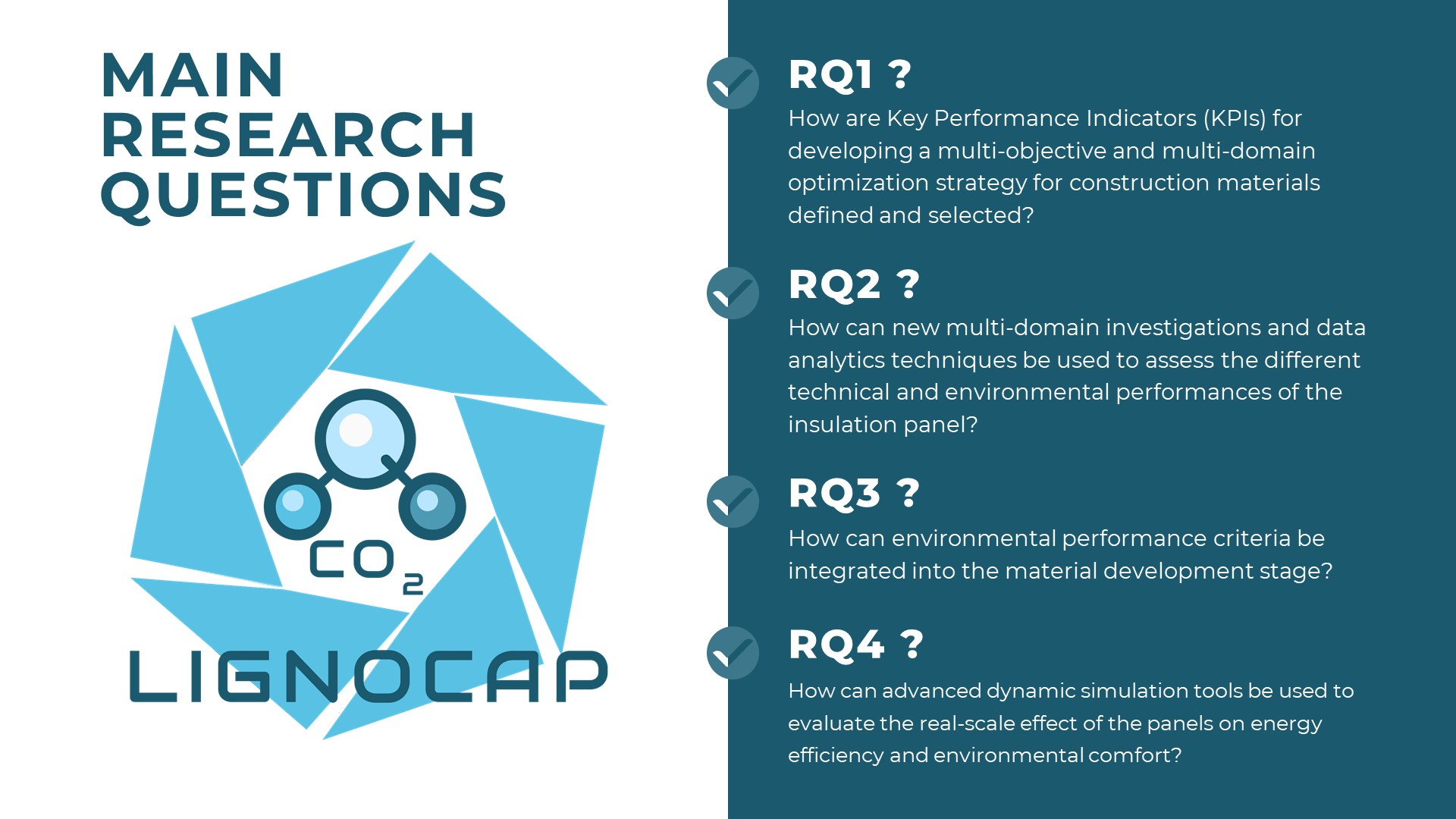
RESEARCH QUESTIONS
OBJECTIVES
Project structure:
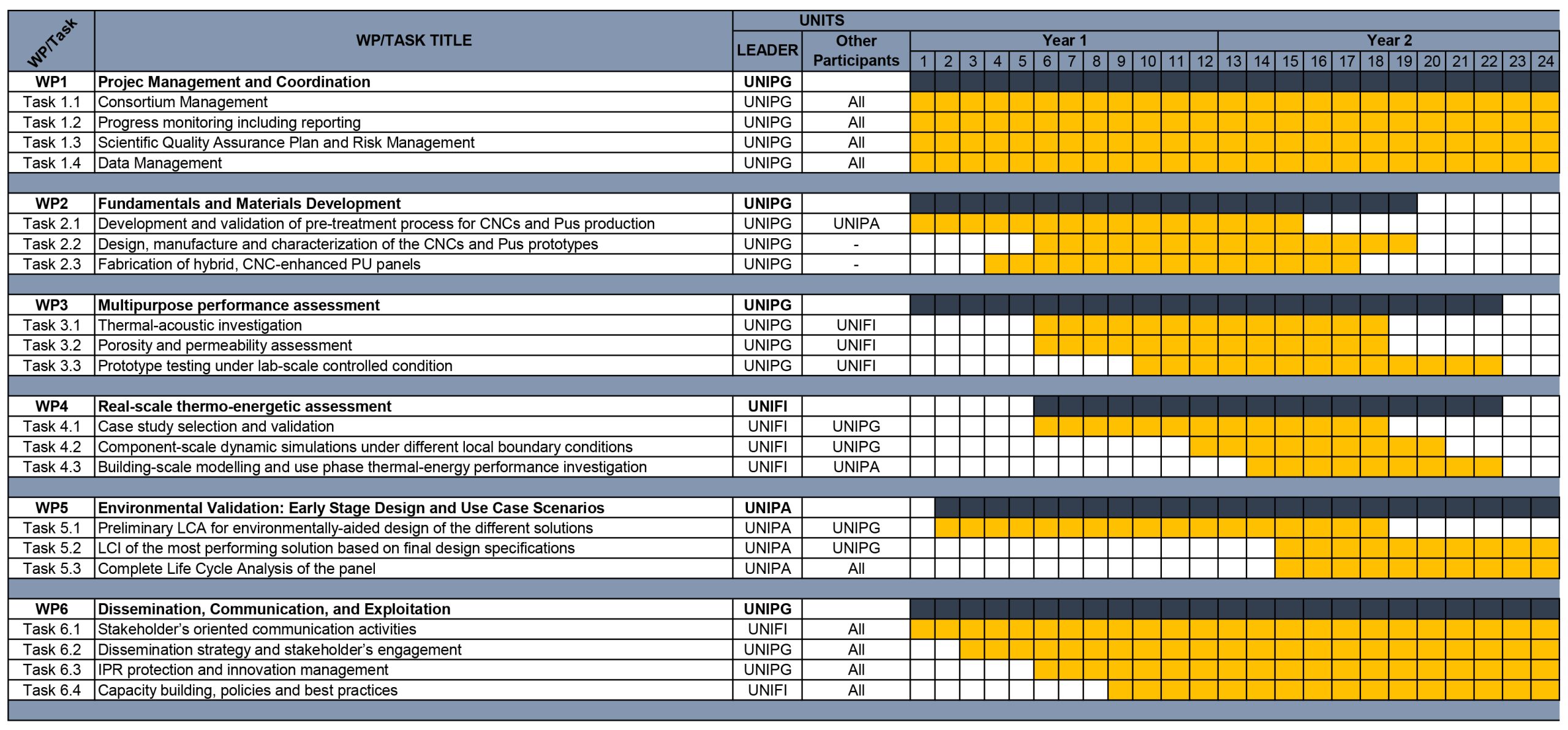
The LIGNOCAP project consists of 6 Work Packages (WPs).
WP1 – PROJECT MANAGEMENT AND COORDINATION (LEADER: UNIPG)
The first WP is focused on project management and will be carried out throughout the whole duration of the project to ensure efficient communication and continuous coordination among the research units collaborating in the project.
WP2 – FUNDAMENTALS AND MATERIALS DEVELOPMENT (LEADER: UNIPG)
In this WP, the bio-based polyurethane panels production process will be developed and optimized through these tasks: development and validation of the treatment process for the production of the panel, design, manufacture, and fabrication of the panel.
WP3 – MULTIPURPOSE PERFORMANCE ASSESSMENT (LEADER: UNIPG)
In this WP, the most important performances (thermal and acoustic properties, porosity and permeability, and stability) of the LIGNOCAP panel will be analyzed employing a multi-physical approach.
WP4 – REAL-SCALE THERMO-ENERGETIC ASSESSMENT (LEADER: UNIFI)
In this WP, different types of opaque envelope components will be selected, as representative of different construction periods and Italian climate zones, to evaluate the integration of the lignin-based panels via validated dynamic hygrothermal calculation codes.
WP5 – EARLY ECODESIGN AND ENVIRONMENTAL ASSESSMENT (LEADER: UNIPA)
This WP will be focused on the environmental sustainability of the LIGNOCAP solution considering each life-cycle step (raw materials supply, manufacturing, operation, maintenance, and end-of-life). Moreover, environmental performance indices will be calculated, useful for evaluating the contribution of the materials/components to circular economy practices.
WP6 – DISSEMINATION, COMMUNICATION AND EXPLOITATION (LEADER: UNIPG)
This WP aims to create the most effective strategies for correctly disseminating and communicating all exploitable results of the project at the national and international level (project website, newsletters, brochures, videos, workshops, presentations, conferences, LinkedIn, Twitter and similar social media, newspapers, and press).
Contact
Email:
info@lignocap.com
Address:
CIRIAF – Interuniversity Research Center, Department of Engineering, University of Perugia, via G. Duranti, 63 06125 Perugia IT